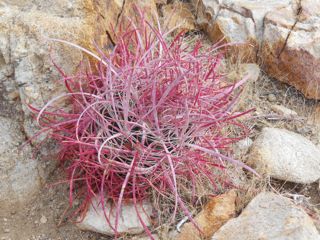
Earlier this month, I made my second visit to Joshua Tree National Park during a weekend in Palm Springs. Despite being March, it was in the low 90s in Palm Springs, so we were more than happy to head to the higher elevation and different climate in Joshua Tree – a beautiful 75 degrees!
 As we only had so many hours in the park, we stuck to a driving tour with brief stops for some short walks. As I observed on my last trip, Joshua Tree has an abundance of short nature walks, but with not a lot of shade and no water available in the park, very few longer hikes. I think Joshua Tree might be more of a climbing/bouldering paradise than hiking… but maybe I need a SoCal native to show me how it’s done.

On our loop, we hit up the 
 Hidden Valley Trail, the Cap Rock Nature Trail, and the Arch Rock Trail. The Hidden Valley Loop is a nice little introduction to the terrain of Joshua tree. The ~1 mile loop circles a valley previously used as a grazing area by cattle smugglers. We saw a couple signs of spring with blooming yucca and a single cactus.

The Cap Rock interpretive loop is very short, but there is a picnic area and an -um- interesting story our hotel manager told us to look up regarding the death of musician Gram Parsons.
 Our favorite little walk of the day was the loop to Arch Rock, the trailhead for which is in the White Tank Campground. The trail takes you to some interesting natural rock formations, but my favorite part was that
  we saw lots of lizards, including two chuckwallas. Chuckwallas can live up to 40 years and grow to something like 15 inches long. We saw an adult male, with the characteristic orange body and black head, and a female (or perhaps a juvenile?) with a greenish brown pattern and a striped tail.
 On our way out of town, I did stop in at the Indian Cove ranger station to pick up one of the passport cancellations I didn’t yet have for the park. Is it cheating if I didn’t stay at the campground? Oh well.


 amenities of campgrounds in the park (I have to say, I am a fan of access to potable water). Some campsites were pretty large, but with nothing but a few Joshua trees for buffer, it did get a little noisy from some of the nearby campers. Not so noisy you couldn’t hear the coyotes crying in the early evening, though. There are some mid-range hiking trails in the area of the campground, but we didn’t check them out this trip. We did discover that Sam’s Market (and pizza and Indian food…) a few miles down the road in the town of Joshua Tree, had a good beer selection and other supplies, such as firewood.
 Perhaps because of the sparse nature of the desert and potentially high temperatures, Joshua Tree seemed to be heavy on the shorter interpretive nature trails, with fewer of the longer half-day and day hike options I usually prefer. At least in terms of established trails – you may want to explore backpacking and backcountry hiking options to get further off the main roads. That being said, it was definitely worth checking out some of these nature trails, particularly as first-time visitors. One of my favorites was the Cholla Cactus Garden on the road that heads toward the southern entrance. They really do look like fuzzy teddy bears, but that’s a mistake you don’t want to make. Barker Dam was basically a dirty puddle when we were there, but you can still walk the trail to spot lizards, learn about different desert plants, and, if interested, see the pictographs “enhanced” by old movie crews.


 Of course one highlight of the park is seeing the eponymous Joshua trees in all their Seuss-like glory. In mid-February, we were a little early for wildflowers (perhaps worsened by the fact it hadn’t yet rained this year due to the drought), but we did get to see a few Joshua trees with their fluffy white pinecone-esque blooms, particularly as we drove up to Keys View, where you can see the entire Coachella Valley, including a quite ominous-looking San Andreas Fault line.