January is an important time of year at Point Reyes. This month not only marks peak season for grey whale migration but also is prime elephant seal breeding time. Being able to observe these two events is a popular draw for visitors, and the park runs buses to ease vehicle traffic to the lighthouse and wildlife viewing areas. I had tried to make the pilgrimage last year, but unfortunately, the one day we picked to make the drive up from the South Bay/Peninsula, the bus broke down blocking access to the road. So there was a year’s worth of anticipation around seeing the whales this year!

The Point Reyes lighthouse, extending far west into the Pacific Ocean, is reportedly one of the best places on the West Coast to see the Grey Whales as they make their journey from Alaska to Mexico. The fact that the whales can be seen from land was a big selling point for my seasick-prone self after the Dramamine didn’t quite do the trick on a humpback whale-watching expedition in Monterey Bay. At the lighthouse, volunteers help to spot and count the whales (and have binoculars onhand if you didn’t bring your own). We saw at least 5 or 6 whales in the time we spent at the lighthouse, including lots of water spouts and a couple tails. While there is a viewing platform above from which you can see the whales, you can also climb the 300+ stairs down to the historic lighthouse to get a closer look. One of the unexpected highlights of our visit was getting to see peregrine falcons and red-tailed hawks dotting the cliff areas around the lighthouse. I had never seen a peregrine falcon before, and they are gorgeous birds! We spent a lot of time watching one chase away two red-tailed hawks invading his territory.


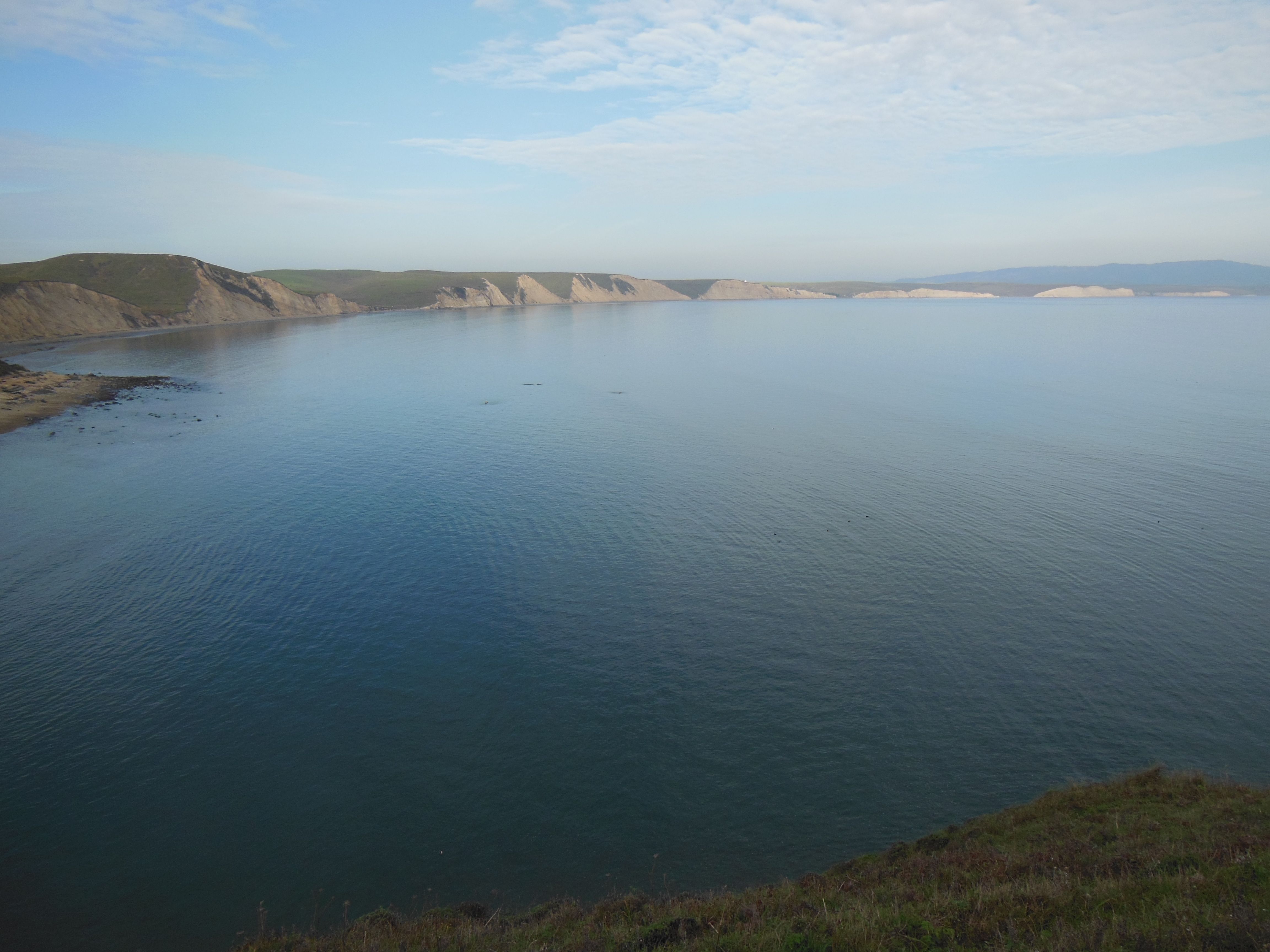
 Just around the corner from the lighthouse, in Drakes Bay, dozens of elephant seals come to land to birth and breed, and their beach can be observed from a viewing area nearby. The same bus that goes to the lighthouse continues to the Chimney Rock Elephant Seal viewing area. Again, volunteers are available for help with viewing and as a great source of information. We saw a couple males with their “harems” and a lot of the little black babies, all born within the past week or two according to the volunteers.

All in all, it was quite a successful day of wildlife watching. In addition to the animals above, we also got to see some deer and elk and some not-so-wild cows on the ride in toward the lighthouse. The area is home to several historic ranches that are still functioning. We got to taste the results by stopping in to pick up some Cowgirl Creamery cheese at Tomales Bay Foods in Point Reyes Station on our way out.
 This was the first time I’ve visited a site run by the National Park Service and forgot my passport book! I did stamp the cancellation and lighthouse stamp on a piece of scrap paper, and it turns out they are the same ones I picked up last year at the other
  visitor’s
  center in the park.


 The Visitor’s Center has a museum and is the base for the U.S.S. Arizona, Utah, and Oklahoma memorials, honoring those ships and the people who perished in the attacks. The museum gives the details of the events of Dec. 7, 1941, including the military details of the attack and the day as it played out for the people of Pearl Harbor. There are some interesting artifacts, including a marked up draft copy of FDR’s famous “a date that will live in infamy” speech. The exhibits definitely freshened my memory from that report I wrote in 3rd grade…
 “centerpiece” of the monument. The memorial is only accessible by boat with a ticket from the Visitor’s Center. The short boat ride across the harbor is preceded by a film, and then visitors are given time for observation at the memorial, which is built immediately over the ship. Almost 1800 men were lost when the ship sunk and are still entombed there. The names of all those lost in the Arizona are engraved onto a wall at the far end of the memorial.
  Interestingly, a side panel also lists the names of U.S.S. Arizona survivors who later requested to be interred there. From the observation deck, you can see fish darting in and out of the corroded metal of the Arizona and oil slicks that to this day still rise to the surface.
 In addition to the U.S.S. Arizona memorial, there is a small, separately managed naval museum including a small sub available for tour at the site of the visitor’s center. I believe a shuttle will also take you over the U.S.S. Oklahoma Memorial, but the Utah is not open to the public as it is on the active military base.


 inclined to
 take that trip on!


 In my last post, I featured spots in Sequoia National Park, but it turns out, Kings Canyon holds its own when it comes to giant sequoias in addition to having gorgeous valleys, granite canyons, and meadows.


 continue East on 180 instead of heading south on the Generals Hwy, you’ll drive down the canyon walls into Cedar Grove and the section of the park that follows the Kings River deeper into Kings Canyon. This area houses the other large campgrounds within Kings Canyon, a visitors center near the campground (where you can find the passport cancellation), and an additional information stand at the aptly named Road’s End. From Road’s End, you can continue on foot 2-3 miles down either side of the river to a bridge. From the bridge, you can return to Road’s End the way you came or down the other side, head up the hill for Mist Falls (apparently “still misting away” this time of year) or head up the Bubb’s Creek Trail to the left.


 but I finally got a to take a long weekend this summer to visit a new (to me) National Park. Parks actually, since Kings Canyon and Sequoia are two adjacent National Parks managed together. I love the Sierras, and these parks just may rival Yosemite as my favorite NP! There were so many highlights to this trip, that this will have to be a multi-part post.


 Further into Sequoia National Park is the Lodgepole area, which has a visitor’s center, campground, market, and other facilities. Lodgepole is one of two places where you can get tickets for the Crystal Cave tour (the other is the Foothills VC near the southern entrance), but we didn’t have time for that one this trip. If you do plan to go into the cave, read the current restrictions on clothing and equipment before you go as efforts are underway to prevent the spread of white-nose syndrome from bat colonies in the Eastern US.


 Muir Woods is a beautiful example of a California redwood forest, with coast redwoods lining a shaded creek surrounded by ferns and a blanket of redwood sorrel. Unfortunately, it is also THE place for people touring CA to get a quick giant tree fix, so you get the trees without the tranquility. There are certainly better places to lose yourself in nature, including redwoods, but the scenery is still able to impress (and as you can see, I managed to get a few pictures without people in them!). Other highlights of the Monument (which likely also contribute to its popularity) are the educational programs and the boardwalked trails through the center of the park, which both protect the woods floor while also making the park more accessible to all visitors.


 If you must visit Muir Woods during summer weekends (as I apparently had to), it is highly recommended that you take the Muir Woods Shuttle (follow signs from the freeway). Another option if you are planning on doing more than just the boardwalk is to hike into the Woods from Mt. Tamalpais State Park. There are several options here: From the Mountain Home Inn, you can take the Panoramic and Ocean View trails into Muir Woods or follow Alice Eastman Road down to the Plevin Cut and Camp Eastwood trails.
 Pantoll Ranger Station, starting with the Stapelveldt and Ben Johnson trails and returning via Bootjack and Alpine. Up at the ranger station, it was all blustery fog and moss-covered trees, but we quickly lost the wind heading down the back side of the hill and had a pretty solitary hike until we got closer to Muir Woods. As you descend, you can see the redwood forest develop as you get further down into the watershed – it’s really quite a nice way to approach! All together, it ended up being about 8 miles and 4 hours, including some meandering about the visitor’s
  center and a stop on the trail for some lunch.
 problem with doing the hike this way is that the uphill is all on the way back! Using the TCC trail as a connector, you could do the loop we did from the end of the Muir Woods trail if you prefer to do the uphill first. My fitbit logged 147 flights of stairs – I was highly tempted to go up and down the stairs at my apartment 3 more times when I got home, but my knee was hurting from all the downhill hiking.


 is without a doubt one of my favorite places in this world. It’s definitely hard to keep up any pretense that I don’t have a favorite park, and I’ve spent my past couple
  birthdays waking up and logging on to recreation.gov to make sure I get those coveted summer camp
 ing reservations.